
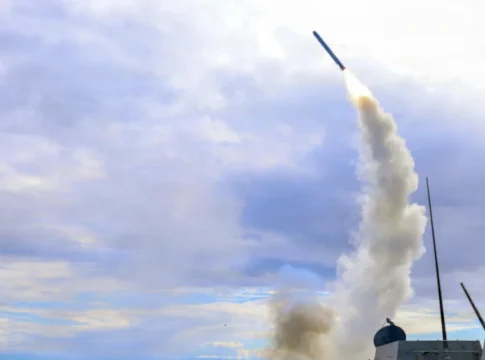
The United States military is depleting its arsenal of Tomahawk cruise missiles in the Iran conflict at a rate far exceeding production capacity, raising critical questions about America’s readiness for sustained military operations and the nation’s ability to defend its interests abroad.
Production Falls Dangerously Short of Combat Use
The Pentagon maintains approximately 3,100 Tomahawk missiles in its current inventory, according to Kelly Grieco, a senior fellow at the Stimson Center. However, actual procurement rates tell a troubling story. The U.S. military purchases only about 90 missiles annually under standard contracts, with the Navy requesting just 57 missiles for fiscal year 2026, according to Defense Department budget documents. Senator Jack Reed of Rhode Island revealed at a recent Armed Services Committee hearing that U.S. forces have fired thousands of Tomahawks and other long-range weapons into Iran during the current conflict.
Defense Industrial Base Struggles to Scale
Maximum production capacity exists to manufacture 2,330 Tomahawk missiles annually through contracts with Raytheon and BAE Systems, according to the Center for Strategic and International Studies, citing Pentagon budget documents. Three Raytheon contracts each hold capacity for 600 missiles, while BAE can produce up to 530 missiles per year. Defense Secretary Pete Hegseth announced last week that the administration is working to accelerate production, promising the nation would be refilled faster than anyone imagined. Raytheon recently agreed to a framework that could scale up to 1,000 missiles annually for American forces over several years.
Strategic Weapon Proves Indispensable
Tomahawk cruise missiles have become the weapon of first choice when American commanders need to strike distant or heavily defended targets without risking pilot lives. Each missile costs approximately 2.2 million dollars for basic versions, while naval variants capable of hitting moving ships exceed 4 million dollars. Launched from Navy destroyers and submarines, these precision weapons can travel more than 1,000 miles and strike with remarkable accuracy against sophisticated air defenses. The missile has been flight-tested over 550 times and used operationally in more than 2,300 strikes from Iraq to Syria. Defense analysts warn that structural limits in the defense industrial base designed for predictable peacetime demand rather than rapid wartime expansion pose the real constraint, beyond simple funding issues.