
Short Guide: AI in Creative Industries
Artificial intelligence is fundamentally transforming the creative industries, introducing new tools, workflows, and possibilities that were unimaginable just a few years ago. From advertising and graphic design to music production and film making, AI technologies are reshaping how creative professionals work, collaborate, and deliver results. This guide explores the current state of AI in creative sectors, its applications, benefits, challenges, and what the future may hold.
Understanding AI’s Role in Creative Work
AI in creative industries primarily functions as an augmentation tool rather than a replacement for human creativity. These systems utilize machine learning algorithms, neural networks, and natural language processing to assist creative professionals in generating ideas, automating repetitive tasks, and exploring new creative possibilities. The technology learns from vast datasets of existing creative work to produce original content or enhance human-created materials.
The integration of AI into creative workflows represents a paradigm shift in how creative projects are conceptualized and executed. Rather than eliminating the need for human creativity, AI tools are enabling creators to work more efficiently, experiment more freely, and push the boundaries of what is technically possible.
Key Applications Across Creative Industries
Visual Arts and Design
AI has made significant inroads in graphic design, illustration, and visual content creation. Generative AI tools can now create original artwork, generate design variations, and even produce complete visual compositions based on text descriptions. Designers use these tools for rapid prototyping, mood board creation, and exploring design directions that might not have been considered otherwise.
Professional applications include automated logo generation, color palette suggestions, layout optimization, and image enhancement. AI-powered tools can remove backgrounds, upscale images while maintaining quality, and even generate photorealistic images from sketches or wireframes.
Content Writing and Copywriting
The written word has experienced substantial AI disruption. Natural language processing models can generate articles, marketing copy, product descriptions, and creative content across various tones and styles. Content creators leverage these tools for brainstorming, drafting initial versions, overcoming writer’s block, and producing content at scale.
Beyond generation, AI assists with editing, grammar checking, style consistency, and SEO optimization. These capabilities have particular value in marketing, journalism, and content marketing where volume and speed often matter alongside quality.
Music and Audio Production
AI technologies are revolutionizing music composition, production, and audio engineering. Machine learning models can now compose original music in specific genres, generate background scores, and even create vocal performances. Audio engineers use AI for mixing, mastering, noise reduction, and sound enhancement tasks that traditionally required extensive technical expertise and time.
Additionally, AI powers music recommendation systems, automatic transcription services, and tools that separate individual instruments from mixed recordings, opening new possibilities for remixing and sampling.
Film and Video Production
Video production has embraced AI across pre-production, production, and post-production phases. Script analysis tools help predict audience reception, while AI-assisted casting platforms match actors to roles. During production, AI powers advanced camera tracking and real-time visual effects.
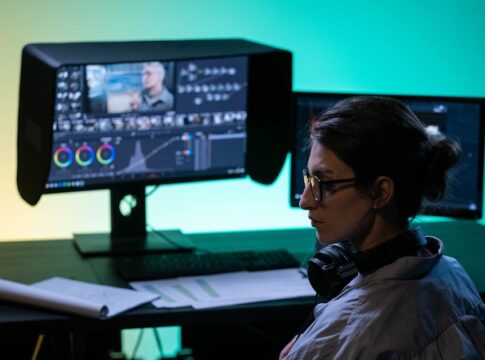
Post-production benefits include automated video editing, color grading suggestions, special effects generation, and even automated subtitle creation and translation. Deep learning techniques enable sophisticated effects like face swapping, age progression, and scene reconstruction.
Benefits Driving AI Adoption
The rapid adoption of AI in creative industries stems from several compelling advantages:
- Increased Efficiency: AI automates time-consuming tasks, allowing creative professionals to focus on higher-level creative decisions and strategy.
- Cost Reduction: Organizations can produce more content with fewer resources, making creative production accessible to smaller businesses and independent creators.
- Enhanced Experimentation: The speed of AI-generated variations enables rapid exploration of creative directions without significant time or financial investment.
- Accessibility: AI tools lower barriers to entry, enabling individuals without traditional training to produce professional-quality creative work.
- Consistency at Scale: Brands can maintain consistent quality and style across large volumes of content.
- Data-Driven Insights: AI analyzes audience preferences and performance metrics to inform creative decisions.
Challenges and Considerations
Despite its advantages, AI integration in creative industries presents several challenges that organizations and individuals must navigate carefully.
Ethical and Legal Concerns
Copyright and intellectual property issues remain contentious, particularly regarding AI training data and ownership of AI-generated content. Questions persist about whether AI systems trained on existing creative works infringe on original creators’ rights. Additionally, the legal framework for AI-generated content ownership continues to evolve across different jurisdictions.
Quality and Authenticity
While AI can produce impressive results, concerns about authenticity, emotional resonance, and genuine creative insight persist. Critics argue that AI-generated content may lack the human experience and emotional depth that distinguish truly meaningful creative work. Maintaining quality standards and avoiding generic or derivative outputs requires careful human oversight.
Job Displacement Concerns
The creative workforce faces legitimate concerns about automation displacing human workers, particularly for routine creative tasks. However, evidence suggests AI is more likely to transform roles than eliminate them entirely, with demand shifting toward AI-savvy creative professionals who can effectively leverage these tools.
Technical Limitations
Current AI systems still struggle with complex creative concepts, nuanced cultural understanding, and maintaining consistency across extended projects. They may produce technically correct but creatively uninspired results without proper human guidance.
The Future Landscape
The trajectory of AI in creative industries points toward increasingly sophisticated tools that better understand context, creativity, and human preferences. Future developments will likely focus on more intuitive interfaces, improved collaboration between human and AI creativity, and systems that better understand and execute complex creative visions.
Success in this evolving landscape will depend on embracing AI as a collaborative tool while maintaining the irreplaceable human elements of creativity: emotional intelligence, cultural understanding, strategic thinking, and genuine innovation. Organizations and individuals who develop expertise in directing and refining AI outputs while preserving authentic human creativity will find themselves best positioned for the future.
As AI technologies mature, the creative industries will continue adapting, discovering new applications, and defining best practices that maximize benefits while addressing legitimate concerns. The most promising path forward involves thoughtful integration that enhances rather than replaces human creativity.