
Short Guide: AI in Creative Industries
Artificial intelligence has rapidly transformed from a speculative technology into a practical tool reshaping creative industries worldwide. From music composition to visual design, AI systems are now integral to modern creative workflows, challenging traditional notions of artistry while opening new possibilities for innovation and efficiency.
Understanding AI’s Role in Creativity
AI in creative contexts refers to machine learning algorithms and neural networks trained to recognize patterns, generate content, and assist in creative decision-making. These systems analyze vast datasets of existing creative work to understand stylistic elements, compositional rules, and aesthetic preferences. Rather than replacing human creativity, AI typically serves as a collaborative tool that augments human capabilities, automates repetitive tasks, and provides new avenues for exploration.
The integration of AI into creative workflows represents a fundamental shift in how content is conceptualized, produced, and distributed. Creative professionals increasingly view AI as another instrument in their toolkit, similar to how digital software revolutionized creative practices in previous decades.
Key Applications Across Creative Sectors
Visual Arts and Design
AI has made significant inroads in visual creative fields through generative image models, automated design systems, and intelligent editing tools. Graphic designers utilize AI for rapid prototyping, generating multiple design variations, and automating layout decisions. These systems can analyze brand guidelines and automatically apply consistent styling across hundreds of assets, dramatically reducing production time.
In fine arts, artists experiment with AI as a collaborative partner, using algorithms to generate unexpected visual elements that inform traditional painting, sculpture, and mixed media work. The technology enables exploration of aesthetic territories that might not emerge through conventional creative processes.
Music and Audio Production
The music industry has embraced AI for composition assistance, mixing optimization, and sound design. AI systems can generate backing tracks, suggest chord progressions, and even create complete compositions in specific genres. Audio engineers employ AI-powered tools for mastering tracks, removing unwanted noise, and balancing complex mixes with precision that would require hours of manual adjustment.
Streaming platforms leverage AI to analyze listening patterns and create personalized playlists, fundamentally changing how audiences discover and consume music. This data-driven approach influences not only distribution but also creative decisions, as artists gain insights into audience preferences.
Writing and Content Creation
Natural language processing has advanced to the point where AI can assist with various writing tasks, from generating initial drafts to editing for clarity and tone. Content marketers use AI to produce blog posts, social media content, and advertising copy at scale. Journalists employ AI for data analysis, identifying story leads, and automating routine reporting tasks.
In creative writing, AI tools serve as brainstorming partners, offering plot suggestions, character development ideas, and alternative phrasings. While the technology cannot replicate the nuanced emotional depth of skilled human writers, it provides valuable support during the creative process.
Film and Video Production
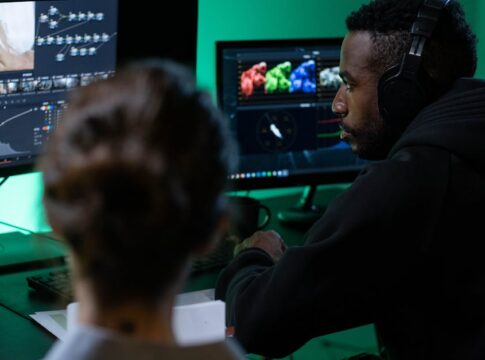
Video production has seen extensive AI integration across pre-production, production, and post-production phases. AI assists with script analysis, predicting audience reception, and optimizing shooting schedules. During editing, automated systems can perform initial cuts based on specified criteria, color grade footage, and enhance audio quality.
Visual effects studios employ AI for motion capture refinement, crowd simulation, and generating realistic digital environments. The technology significantly reduces rendering times and enables smaller teams to achieve production values previously accessible only to major studios.
Benefits and Opportunities
The adoption of AI in creative industries offers numerous advantages that extend beyond simple efficiency gains:
- Increased productivity through automation of repetitive technical tasks, allowing creative professionals to focus on high-level conceptual work
- Enhanced accessibility, enabling individuals without extensive technical training to produce professional-quality creative work
- Cost reduction in content production, democratizing access to creative tools and lowering barriers to entry
- Rapid prototyping and iteration, allowing exploration of multiple creative directions quickly
- Data-driven insights that inform creative decisions and help predict audience responses
- New creative possibilities that emerge from human-AI collaboration, generating novel aesthetic expressions
Challenges and Considerations
Despite its potential, AI integration in creative fields raises important questions and challenges that industries must address:
Intellectual Property and Ownership
The question of who owns AI-generated content remains legally ambiguous in many jurisdictions. When AI systems trained on existing works generate new content, determining copyright ownership and respecting original creators’ rights becomes complex. Creative industries continue grappling with these questions as legal frameworks struggle to keep pace with technological advancement.
Authenticity and Value
As AI-generated content becomes more prevalent, questions arise about authenticity, originality, and the value of human creativity. Some argue that art’s intrinsic value lies in human experience and emotional expression, which AI cannot genuinely replicate. Industries must balance efficiency gains with maintaining the perceived value of human-created work.
Economic Disruption
AI automation potentially displaces workers in creative fields, particularly those performing routine technical tasks. While new opportunities emerge for those who master AI tools, industries face challenges in workforce transition and ensuring equitable access to retraining opportunities.
The Path Forward
The future of AI in creative industries likely involves increasingly sophisticated human-machine collaboration rather than wholesale replacement of human creativity. Successful integration requires thoughtful implementation that respects creative values while embracing technological capabilities.
Creative professionals who develop fluency with AI tools while maintaining core creative skills will be best positioned to thrive in evolving industries. Organizations must invest in training, establish ethical guidelines for AI use, and foster cultures that view AI as a creative partner rather than a threat.
As AI technology continues advancing, creative industries stand at a crossroads where thoughtful adoption can enhance human creativity while careless implementation risks diminishing what makes creative work meaningful. The goal remains clear: leveraging AI to expand creative possibilities while preserving the irreplaceable human elements that give creative work its soul.