
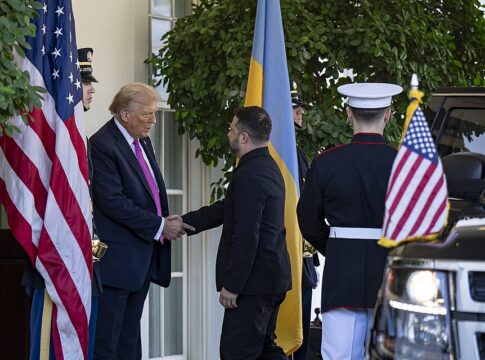
President Donald Trump announced Wednesday that the United States will grant Ukraine a license to manufacture Patriot air defense systems domestically, marking a dramatic departure from simply supplying American-made weapons to enabling foreign production of one of America’s most sophisticated defense technologies.
Sudden Policy Reversal Catches Defense Contractors Off Guard
During a White House meeting with Ukrainian President Volodymyr Zelenskyy, Trump initially suggested the two leaders would discuss the possibility before abruptly declaring the decision final. “We’re going to give a license to you to make Patriots,” Trump told Zelenskyy. “That’s pretty cool. Right? This way you can’t complain that we’re not giving them enough. I’d say make them yourself.” The president then acknowledged that RTX, the defense contractor manufacturing Patriot systems, had not yet been informed of the decision.
Trump’s announcement left critical details unclear, including whether the license covers just interceptor missiles or complete Patriot systems, and whether production would occur in Ukraine, Europe, or both. The president’s comments that “they’ll be thrilled” about the licensing arrangement raised immediate questions about how advanced the plan actually is and what role American defense contractors would play in any manufacturing agreement.
Complex Manufacturing Presents Major Obstacles
The Patriot system represents one of the world’s most sophisticated air defense platforms, with RTX producing radars, launchers, and PAC-2 GEM-T interceptors while Lockheed Martin builds the advanced PAC-3 Missile Segment Enhancement interceptor designed to defeat ballistic missiles. Defense officials and industry executives have stated that producing a single Patriot interceptor requires more than two years, relying on hundreds of specialized suppliers and complex manufacturing processes that have made it difficult to replenish stockpiles.
Ukrainian officials have warned that Patriot interceptor supplies have fallen to dangerously low levels as Russia intensifies missile strikes against cities, energy infrastructure, and military targets. Zelenskyy arrived at the NATO summit seeking additional interceptors from allies while pressing for longer-term production expansion, arguing current manufacturing cannot keep pace with Russia’s growing missile campaign.
Strategic Implications For American Defense Technology
Trump framed the decision around the defensive nature of Patriot systems, stating he preferred defensive weapons over offensive ones. The licensing arrangement could fundamentally alter America’s approach to military aid, shifting from direct weapon transfers to technology sharing that enables allies to produce their own defense systems. This policy change comes as Patriot systems remain critical for protecting Ukrainian infrastructure and as defense production struggles to meet surging demand from conflicts in Ukraine and the Middle East.