
Quick Insight: Augmented Reality Apps
Augmented reality (AR) technology has evolved from a futuristic concept to an integral part of daily digital experiences. AR apps overlay digital information, graphics, and interactive elements onto the real world through smartphone cameras and specialized devices, creating immersive experiences that blend physical and virtual environments. As this technology continues to mature, AR applications are transforming industries ranging from retail and education to healthcare and entertainment.
Understanding Augmented Reality Technology
Augmented reality differs fundamentally from virtual reality by enhancing rather than replacing the real world. AR apps use device cameras, sensors, and processing power to recognize physical environments and superimpose digital content in real-time. This technology relies on several key components, including computer vision, simultaneous localization and mapping (SLAM), depth tracking, and advanced rendering capabilities. Modern smartphones have become increasingly capable AR platforms, with processors specifically designed to handle the computational demands of augmented reality experiences.
The accessibility of AR technology has expanded dramatically as major technology companies have developed standardized frameworks. ARKit for iOS devices and ARCore for Android platforms have provided developers with powerful tools to create sophisticated AR experiences without requiring extensive specialized knowledge. These frameworks handle complex tasks such as motion tracking, environmental understanding, and light estimation, enabling developers to focus on creating engaging user experiences.
Major Categories of AR Applications
Retail and E-Commerce
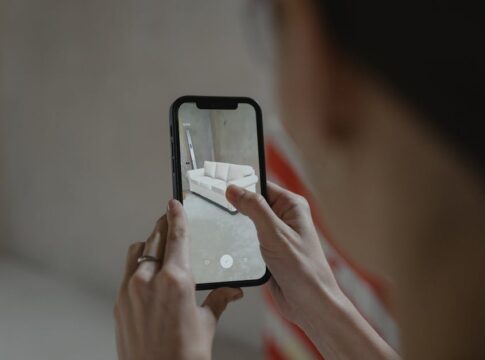
The retail sector has emerged as one of the most prominent adopters of AR technology. Virtual try-on applications allow customers to visualize how furniture would look in their homes, how clothing items would fit their bodies, or how cosmetics would appear on their faces before making purchase decisions. Major retailers have reported significant increases in customer engagement and reductions in product returns after implementing AR features. These applications address the fundamental challenge of online shopping by bridging the gap between digital browsing and physical product experience.
Navigation and Wayfinding
AR navigation apps have revolutionized how people find their way in both outdoor and indoor environments. By overlaying directional arrows and information directly onto live camera views, these applications provide intuitive guidance that surpasses traditional map-based navigation. Indoor navigation solutions help users navigate complex buildings such as airports, shopping malls, and hospitals, where GPS signals are unreliable. This technology has proven particularly valuable for accessibility, offering enhanced wayfinding support for individuals with visual or cognitive impairments.
Education and Training
Educational institutions and corporate training programs increasingly leverage AR apps to create interactive learning experiences. These applications can bring textbook content to life with 3D models, animate historical events in actual locations, or provide hands-on practice with virtual equipment. Medical students use AR apps to study anatomy by examining detailed 3D models of human organs and systems. Industrial training programs employ AR to simulate dangerous scenarios safely or guide technicians through complex repair procedures with step-by-step visual instructions overlaid on actual equipment.
Gaming and Entertainment
The entertainment industry has embraced AR technology to create novel gaming experiences that encourage physical activity and social interaction. Location-based AR games transform neighborhoods into playgrounds, encouraging players to explore their surroundings while interacting with virtual characters and objects. Museums and cultural institutions use AR apps to enhance exhibits with additional context, reconstructions of historical scenes, and interactive elements that engage visitors in new ways.
Business Applications and Enterprise Solutions
Beyond consumer-facing applications, AR technology has found substantial utility in enterprise environments. Manufacturing facilities use AR apps to provide workers with real-time information about machinery, quality control guidelines, and assembly instructions without requiring them to consult separate documentation. Remote assistance applications enable experts to see what field technicians see and provide guidance by annotating their view with virtual markers and instructions.
Architecture and construction professionals utilize AR apps to visualize building designs at actual sites, identify potential conflicts before construction begins, and communicate design intentions more effectively with clients and stakeholders. These applications can overlay proposed structures onto empty lots, allowing all parties to understand spatial relationships and design impact in context.
Technical Challenges and Limitations
Despite significant advances, AR applications still face several technical challenges. Battery consumption remains a concern, as AR apps require continuous use of cameras, sensors, and processors. Tracking accuracy can degrade in certain environments, particularly those with poor lighting, reflective surfaces, or limited visual features. Privacy concerns arise as AR apps necessarily collect detailed information about user environments and movements.
Network connectivity presents another challenge for AR experiences that rely on cloud processing or real-time data. The rollout of 5G networks promises to address bandwidth and latency issues, potentially enabling more sophisticated AR experiences that leverage cloud computing capabilities.
Future Developments and Trends
The AR application landscape continues to evolve rapidly. Advances in wearable AR devices, including smart glasses and headsets, promise to make augmented reality more seamless and hands-free. Artificial intelligence integration is enhancing AR apps with improved object recognition, semantic understanding of environments, and personalized content delivery.
Web-based AR technologies are eliminating the need for dedicated app downloads, allowing users to access AR experiences directly through browsers. This development significantly lowers barriers to entry and enables broader adoption of AR technology across various use cases.
Conclusion
Augmented reality apps have transitioned from novelty to necessity across numerous sectors. As hardware capabilities improve, development tools become more accessible, and network infrastructure advances, AR applications will continue to find new applications and achieve deeper integration into professional and personal workflows. Organizations and individuals who understand and leverage AR technology position themselves to benefit from enhanced experiences, improved efficiency, and new forms of engagement with digital information and services.